Future of Rail | Overview
Travel light
If the Coventry ‘very light rail’ system delivers the benefits its promoters anticipate, what are the implications for the UK’s wider urban transport network? Helena Russell reports.
Construction of the Coventry Very Light Rail (CVLR) demonstration track has moved a step closer, after the West Midlands Combined Authority Board gave the green light for the project’s first £35M instalment in January. If it is built and the CVLR trials are successful, urban peoplemover technology could be opened up to many smaller cities across the UK.
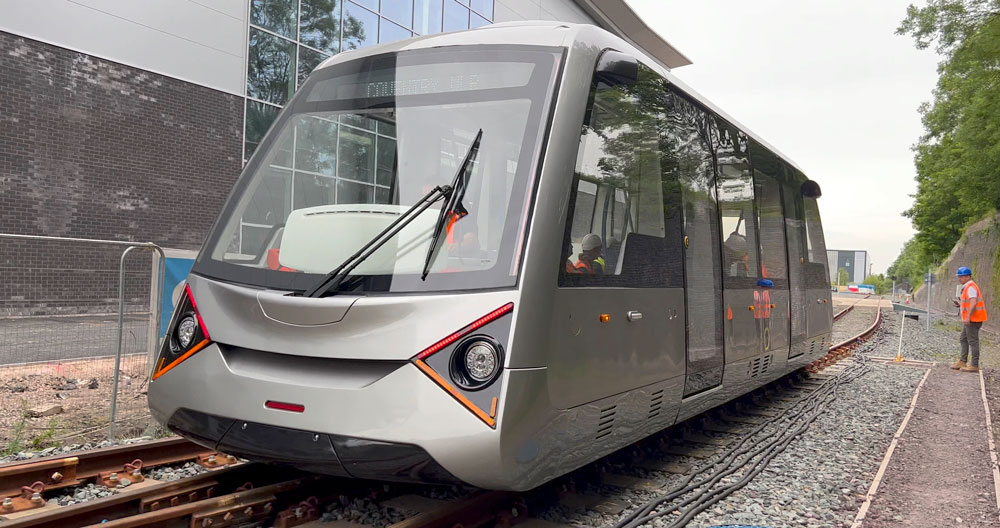 A bespoke autonomous vehicle with on board power supply is being tested as part of the CVLR project
The instalment is part of a proposed £72M investment in the development of very light rail technology in the region through the Department of Transport’s (DfT’s) City Region Sustainable Transport Settlement.
Although the first £35M tranche of funding is still awaiting final sign off by the DfT, testing of a bespoke vehicle and new track design are already under way.
The CVLR project involves development and testing of a very light rail demonstrator system in Coventry, including a new trackbed design and bespoke autonomous vehicles with on board power supply. It is being funded by the West Midlands Combined Authority, the Coventry and Warwickshire Local Enterprise Partnership and Coventry City Council.
CVLR programme manager Nicola Small says that the key aim of a very light rail system is to reduce the cost of implementation and operation, rather than necessarily the weight or size of the system.
Traditional light rail systems are too expensive to build and operate in places the size of Coventry, which has a population of just 365,000. What is more, the 200-person capacity vehicles that they typically employ would be too big: “We just don’t have that kind of demand,” admits Small.
Even so, smaller cities with sprawling suburbs still have key corridors that would benefit from this type of permanent infrastructure transport network.
“We have the same problem with congestion and air pollution as larger cities,” says Small. “People want attractive modes of transport to help them make a modal shift, so there’s a gap in the market for something that’s between a bus and light rail and that is affordable,” she says.
By redesigning some elements and eliminating others, CVLR’s team believes it can cut costs for such a system to around a third of the average of £30M per kilometre.
Small is at pains to point out that Coventry’s pitch for very light rail is intended to complement rather than undermine bus services in the city as part of an integrated solution.
“In 2025 we will be the first all-electric-bus city in the UK,” she adds.
“And when you look at cities like Nottingham that invested in buses at the same time as delivering a tram network, bus patronage has gone up and the tram has achieved modal shift.”
KEY FACT
£10MApproximate estimated cost of CVLR’s new track per kilometre
The team developing the CVLR has been focusing on a number of cost-saving elements, according to Warwick University Warwick Manufacturing Group principal engineer Christopher Micallef.
He points out that making the system physically lighter or smaller was not the principal concern. Instead, it was about eliminating or redesigning items where the biggest savings could be made, such as the catenary, track installation and driver-operated vehicles.
Recent developments in the automotive industry, particularly in battery technology and autonomous vehicle control have been useful in this regard, Micallef says. He believes that the CVLR system with smaller, driverless vehicles and on board power is leading the way and that the market will naturally go in that direction once these technologies become commonplace.
The new trackbed design is expected to enter testing under full highway vehicle loading at the council’s waste disposal facility in Whitley, a suburb of Coventry, in the coming weeks. The trackbed has a depth of less than 300mm compared to the conventional trackbed depth of 500mm and above. Micaleff’s team developed a bespoke specification for the CVLR trackbed, then reviewed what was currently available on the market, finding nothing to suit.
The bespoke design exploits recent developments in materials technology such as ultra-high-performance concrete, eliminating the need for a concrete base layer and reducing installation costs and the potential impact on utilities along the route.
As trackbed testing progresses, Micallef’s team believes it will prove capable of carrying heavier rail vehicles than anticipated, which could have significant implications for other light rail systems.
The extent of testing and validation that is required to satisfy all stakeholders is one of the biggest challenges for Micallef. He points out that many existing systems have become accepted by being proven in service rather than being developed from first principles and that there is no agreed standard for this type of infrastructure.
GAME CHANGER
“The next stage of the process is that we want to test the premise that our trackbed could support heavier vehicles,” Small says. “If it can, this will be game-changing in the industry.”
Transport for West Midlands has secured funding to carry out this research, the results of which could open up a much cheaper delivery option to those operators unable to secure funding for their extensions.
Where there is a lower demand, CVLR’s vehicles could also be used.
“There’s a gap in the market for something that’s between a bus and light rail and that is affordable
A prototype “first of a kind” vehicle has also been developed by CVLR’s team and is currently being tested at the Very Light Rail Innovation Centre in Dudley.
“Apart from being much smaller than a traditional vehicle – it is fully battery operated so there is no need for overhead catenaries – and it has a novel bogie that enables it to go round much tighter corners,” Small adds.
The fact that CVLR is a research and development programme means are bound to be challenges, she admits. At the same time as the trackbed undergoes bi-directional highway loading at the council’s waste disposal facility, some elements will be tested in the track loop in Dudley where the new vehicle is being put through its paces. The ultimate test will be construction and operation of a full-size demonstrator that is planned to be built on Coventry streets. It will not carry passengers but is intended to test and showcase the construction and operation of the system in a real-life environment.
ONE SIZE FITS ALL?
Transport for Greater Manchester (TfGM) transport strategy director Simon Warburton can clearly see the benefits of such a system for places like Coventry, but says very light rail is incompatible with Manchester’s future transport plans due to the nature of its existing infrastructure.
“More investment is needed given that congestion and the health issues associated with pollution are concerns“Originally Metrolink [Greater Manchester’s tram/light rail system] was built on existing commuter rail lines, creating a link across the city using the Bury and Altrincham lines. The high platforms were retained as a way of reducing the cost,” he explains.
“Ironically the retention of these platforms is now proving of benefit to us – and another reason why very light rail doesn’t really work for us – in that it gives us the opportunity to move into tram-train development far more easily than other places.”
Tram-train systems allow heavy rail and light rail or trams to share the same track.
“There’s tonnes of capacity on the rail lines once you get out of the congested central area of Manchester,” Warburton says. “We know that the most attractive facet of Metrolink for the user is its frequency. Even at just five services an hour it would offer a step change on those routes that only have two services an hour at the moment.”
In this scenario, any new rolling stock Metrolink buys is likely to get heavier rather than lighter, he explains. “If we go in the tram-train direction, we will have to go for more substantial rolling stock in order to meet the safety case. Even with a sophisticated signalling system you have to guard against the eventuality of those vehicles finding themselves on the same length of track. For these reasons we are moving away from a light rail model to more of a mixed model.”
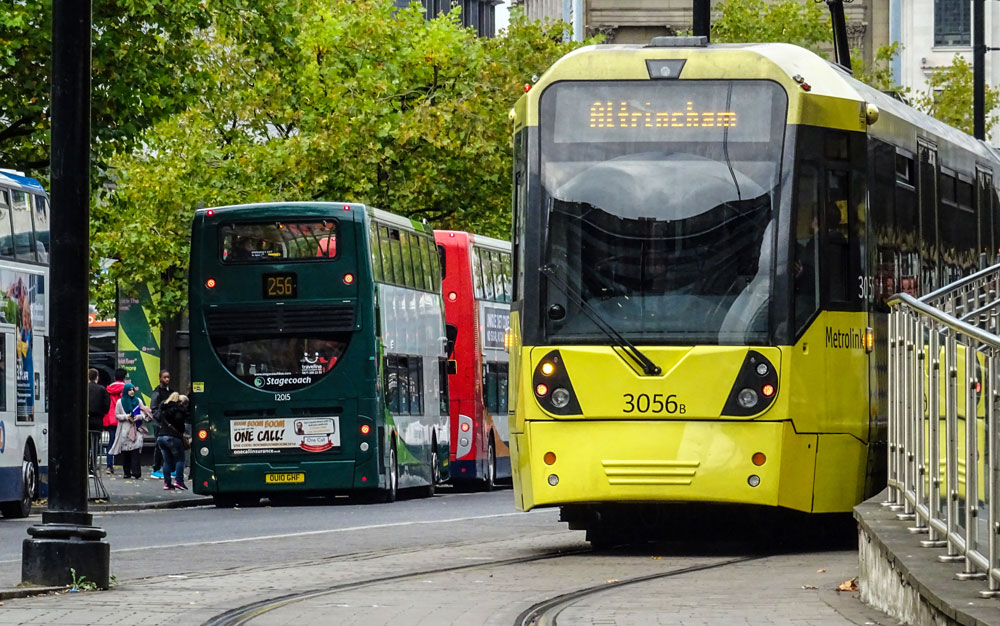 High platforms on Greater Manchester’s Metrolink tram/light rail system could assist tram-train systems
INVESTMENT SOURCES
TfGM is now focused on developing a “pathfinder” project in the north of the city, but Warburton warns that an absence of any agreement from the government on a funding model for such projects is the main issue faced by all light rail promoters.
“We know we are in slightly more challenging times in terms of demand, but it’s important we don’t lose sight of where we have come from. The demand in Greater Manchester at the moment is a little short of where it was, but it’s still more than double where it was at the turn of the century,” says Warburton.
“We’re going to continue to see growth in urban populations, we’re going to continue to see growth in urban employment models – that gap will fill itself. It’s just a temporary issue and we will move beyond it. It needs a 10-year commitment – you have to invest ahead in order to have the infrastructure in place.”
Mott MacDonald global sector lead on transport Chris Dulake agrees. He adds: “More investment is needed given that congestion and the health issues associated with pollution are concerns for city centre residents.
“Globally, it’s quite obvious that many of the big transport projects that are underway at the moment are ones that predate the pandemic.
“Once people have used light rail, they understand how useful it is for improving mobility around cities
“There’s a scarcity of public finance to develop these bigger schemes but there’s still a massive demand for urban mobility and decarbonisation of transport systems by removal of cars primarily from towns and city centres.
“Something that we might see becoming more prevalent is market-led proposals into that light rail space. There is quite an opportunity that private companies might identify to deliver those systems. While PPP [public-private partnership] is not necessarily going to come back, market-led proposals might be a way of doing it.”
Persuading politicians that the travelling public wants light rail can be an uphill struggle, he says. “But more and more people want these systems and I can see that trend getting bigger. Once people have used light rail, they understand how useful it is for improving mobility around cities,” Dulake points out.
The CVLR scheme brings into focus some of the problems that promoters of light rail systems face, he adds.
“It’s about the space available, the width of the streets and environment and its ability to fit it within the public realm in towns and cities. But there are lots of other cities that have a similar sort of ambition to Coventry – their challenge will be in developing their own solutions around these forms of transport.”
Dulake is aware of combined systems working effectively elsewhere – the recently-opened Uithof extension of Utrecht’s light rail system in the Netherlands has light rail sharing a transport corridor with electric buses and running at low speeds through shared environments while able to adjust to higher speeds across other parts of the network.
UNDER CONSTRUCTION AND PLANNED LIGHT RAIL
Blackpool Tramway
Existing tramway is 18km linking Blackpool and Fleetwood. Construction of the extension to Blackpool North station is behind schedule with completion now due in 2023.
West Midlands Metro
This 22km route is mainly on the former rail alignment between Wolverhampton and Birmingham but with on-street sections in the city centres. Three extensions are under construction: Wednesbury to Brierley Hill; Wolverhampton City Centre; and Birmingham Eastside to Deritend. Cambridge Plans for the
Cambridge
Autonomous Metro were ditched in 2021 after a change in political leadership at the city council. But a proposal for a 55km light rail system to be delivered in three phases has been put forward by Cambridge Connect and Railfuture with support from partners including UK Tram and Amey.
Preston
A 200 m-long demonstration tram track is planned to be built in Ribbleton. If the demonstration is successful, it could form part of a 5km long, privately funded route between Red Scar and the city’s university quarter.
South Wales Metro
The South Wales Metro is currently under construction in the Cardiff Capital Region. The proposals are for a fully integrated public transport system using light rail to support an enhanced heavy rail network. In 2018 KeolisAmey won a £5bn contract to run rail services in Wales for 15 years including plans to provide an on-street tramway in Cardiff by 2023. But the service was brought under Welsh Government control, as an Operator of Last Resort in February 2021 due to a significant reduction in passenger numbers during the pandemic. Welsh ministers have pledged to honour commitments for the new trains and South Wales Metro.
West Yorkshire
The West Yorkshire Combined Authority has outlined plans for an estimated £4.2bn system linking Leeds with surrounding cities including Bradford, Halifax, Huddersfield and Wakefield, supported by Northern Powerhouse Rail.
Edinburgh
An extension to the Edinburgh tram system that is currently under construction will add 4.7km of track and eight stops between the city centre terminus, Leith and Newhaven. Work began in November 2019 with passenger services slated to start this year.